Short results card
One generated card that carries the whole result, and can be saved as an image.
Decision: ⚪ idea
Design: Figma
Context
The short results phase - see phases model - shows a single card and two actions: open the full results, or download the card. It is the same object either way. On screen it is the summary; saved, it is a PNG the taker can post anywhere.
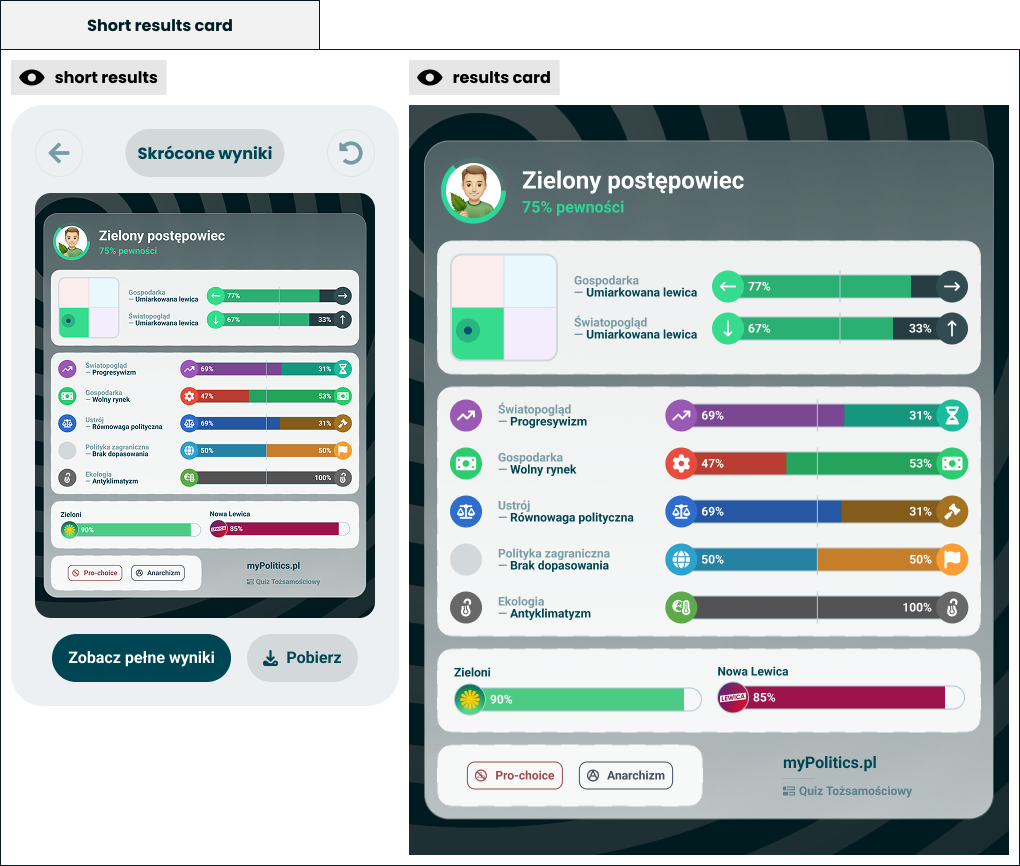
The card is a template filled with the quiz's own result modules, in a fixed order:
- Identity - avatar, archetype name and how confident the result is - see archetype.
- Position - the compass with the leading axes beside it - see Nolan chart and double axis chart.
- Axes - every scored axis as a labelled bar - see multi axis chart.
- Matches - the closest parties or figures.
- Traits and branding - the traits earned, then myPolitics and the quiz name.
How it behaves:
- Template, not a layout - the slot order is fixed for every quiz, so the card is recognisable as ours before anyone reads it.
- The blocks are the quiz's own modules - whatever the author configured is what the card renders; nothing here is written twice.
- A missing module leaves no gap - a block whose module is not configured is not drawn at all, and the card shrinks to fit what remains.
- The branding is not a slot - the footer travels with every shared image, and it is the only part the taker cannot remove.
- Download is one tap - offered in the phase where the taker is already looking at the card, not buried in the full results.
- Short first, full second - the card summarises; the full result screen is the place to actually read it.
Opportunity
- This is the distribution mechanism - a result worth posting is how the product has always spread, and the card is the thing that gets posted - see how.
- Every quiz gets a designed result for free - a community quiz with no design work behind it still produces a card that looks like ours.
- One template covers every quiz shape - a two-axis quiz and a twelve-axis quiz both resolve into the same card, because the blocks come and go.
- Staged payoff - a complete summary immediately, with the full screen still ahead of the taker.
- Branding travels further than the link - a screenshot carries the source even when the URL does not.
Risk
- A shrinking card can shrink to nothing - a minimally configured quiz produces a card that looks broken rather than minimal, so the template needs a floor.
- An image is a public statement - once saved, our sentence about someone's politics circulates without the explanation that sat next to it.
- Numbers lose their caveats - "100%" on an axis reads as certainty about a person when it describes a handful of answers, and the info modals that explain it do not travel with the PNG.
- Party matching is the sharpest claim on the card - it is the block most likely to be screenshotted, argued with, and attributed to us.
- Confidence is easy to misread - a percentage next to the archetype looks like a claim about how good the quiz is, not how complete the answers were.
- The image has to render identically everywhere - fonts, avatars and emoji that shift between devices turn our one shareable artefact into an inconsistent one.