Comparison modes
Who you can hold your result up against: a friend, or an orientation.
Decision: ⚪ idea
Design: Figma
Context
Comparison mode is the second tab of the result screen, and it starts with one choice: compare with a friend, or compare with an orientation.
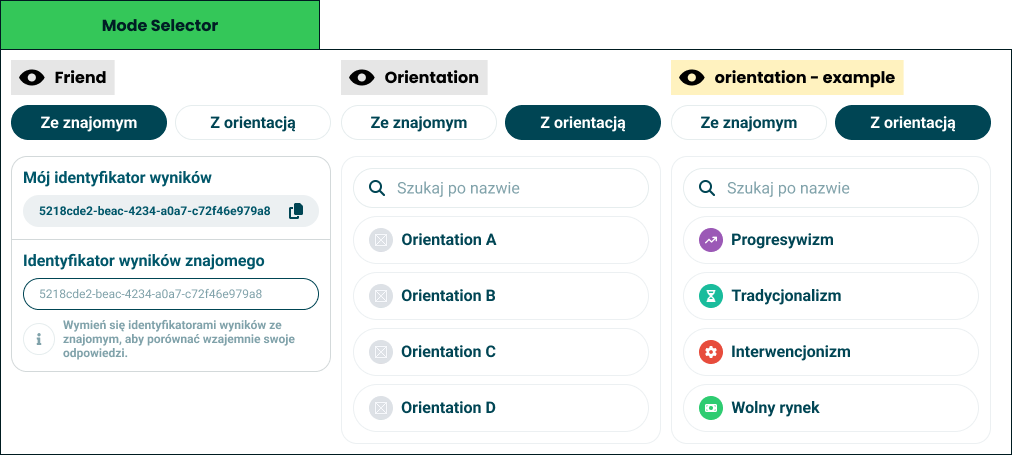
- With a friend - each side has a result identifier. You copy yours, they copy theirs, and pasting one in pairs the two results. Nothing is looked up by name, and nobody is searchable.
- With an orientation - a searchable list of everything the quiz scores, so the taker can hold their answers against progressivism, the free market, a party or a candidate.
What each mode can show:
- A friend gives both - results comparison across every module, and answers comparison question by question.
- An orientation gives answers only - an orientation has no result of its own to overlay, so only the question-by-question view applies.
- Either way an agreement score appears - see agreement info, which stays on screen for as long as the comparison lasts.
Opportunity
- Comparison is the social half of the product - a result is worth reading once, and worth arguing about repeatedly.
- Identifiers keep it private - no friend graph, no accounts to find, no directory of people's politics. The exchange happens in a chat we never see.
- Orientation mode has no second person - it works for a taker with nobody to compare against, which is most takers.
- It reuses every module - comparison is an overlay on what is already drawn, not a second result screen.
- It answers the question people actually ask - "am I more X than you" is the reason results get shared at all.
Risk
- An identifier is a bearer token - whoever holds it can see that result, and people will paste it into public places.
- Pairing is unequal - the person who pastes sees the comparison first, and the other may never see it at all.
- Comparing with an orientation invites a scoreboard reading - "95% progressive" becomes a label, not a comparison.
- Two modes on one tab is a decision before a payoff - the taker has to pick a mode before seeing anything interesting.
- A friend's result is someone else's sensitive data - once compared, it has been shown to a second person, and no consent flow made that explicit.