Nolan chart path
Draws the route the taker's position has travelled across the compass so far.
Decision: ⚪ idea
Design: Figma - two or three quadrants | four quadrants | four quadrants, second path
Context
Every other checkpoint reports a position. This one reports the movement between positions: the compass is drawn with a dotted trail from where the taker started to where they are now, and the card counts how many quadrants that trail has crossed - see checkpoints for the shared card frame and event model for what makes it fire.
Two versions of the same card:
- Two or three quadrants - the ordinary case, played for self-deprecation. "What am I doing here? - so far you have wandered through 3 quadrants of the compass!"
- All four - the rare one, played as an achievement. "Quite a journey - you have already been through every quadrant of the compass."
| Two or three quadrants | All four |
|---|---|
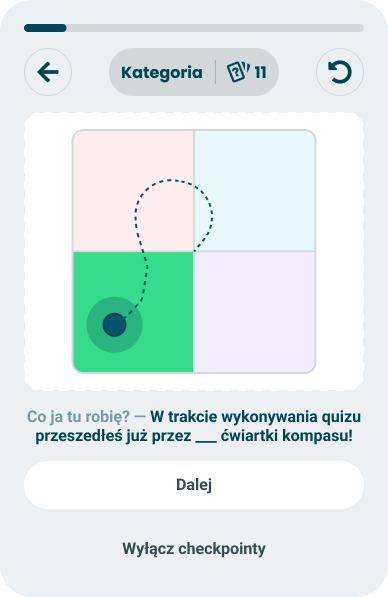 |
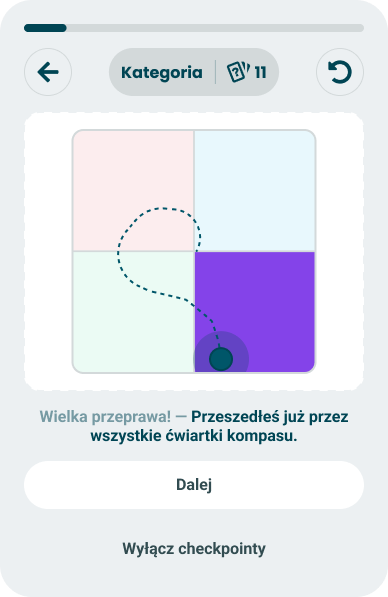 |
How it behaves:
- Fires on movement, not on confidence - the opposite gate to axis closeness. This card is interesting precisely when the reading has not settled.
- Needs at least two quadrants - a taker who has never left one quadrant has no path to show and never sees the card.
- Reuses the compass - the same Nolan chart as the result screen, with the trail and the current quadrant highlighted on top.
- Held until the count means something - fired too early, "you crossed two quadrants" describes three answers rather than a person.
- The four-quadrant version can still follow - it is a rarer statement than two or three, so it is allowed to appear later in the same quiz even if the smaller version already did.
- Passive - continue, or turn checkpoints off.
Opportunity
- It rewards the takers nothing else can reach - someone whose views are spread across the compass has no clean axis finding to be given, and this turns that into the point rather than the problem.
- Movement is a story - a trail is the only visual in the quiz that shows the taker something happening over time instead of a value.
- It sets up the result - meeting the compass mid-quiz makes the final position readable, and the trail explains why it landed where it did.
- No configuration - any quiz with a compass gets it for free.
- The trail is worth keeping - it is a natural thing to replay on the result screen or to share.
Risk
- We may be dressing up noise - early in a quiz the position swings because there is almost no data, not because the taker changed their mind, and calling that a journey is a claim about a person that the numbers do not support.
- It can undercut the result - showing how much the position wandered invites the taker to trust the final one less.
- The quadrant is a partial spoiler - the card names where they currently sit, which is a piece of the result screen handed over early.
- Timing conflicts with the count - the count needs answers behind it, so the card wants to be late, which is where pacing is trying to push the taker towards finishing.
- Two cards for one idea - allowing the four-quadrant version after the two-or-three version spends two pacing slots on the same mechanic.
- Needs a compass - a quiz without a Nolan chart cannot run it, so the event model needs a fallback.