Double axis puzzle
Shows how close the taker is to a named position without saying which one, and asks them to guess it.
Decision: ⚪ idea
Design: Figma - ask | guessed right | guessed wrong
Context
The harder sibling of the single axis puzzle. There the fill is hidden and the poles are named; here the fill is shown and the name is hidden, so the taker knows they are close to something and has to work out what - see checkpoints for the shared card frame and event model for what makes it fire.
The card runs in three states:
- Ask - a closeness bar drawn at its real value with the label masked, offered against three named positions. "What do you think - you are very close to one of these, guess which!"
- Hit - the label uncovers into the full archetype row, name and avatar and all. "Got it - the green progressive is very close to you at this stage of the quiz."
- Miss - nothing uncovers. "Missed - someone else is closest to you. Who? We are not telling yet!"
| Ask | Hit | Miss |
|---|---|---|
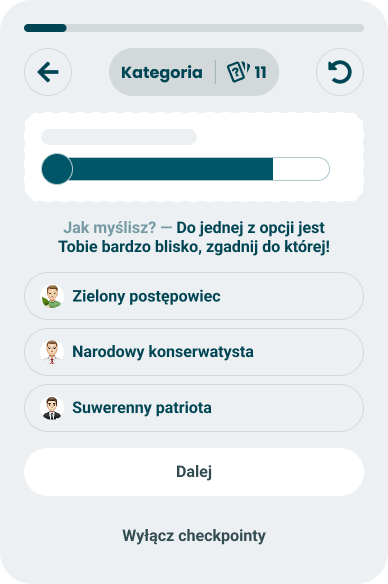 |
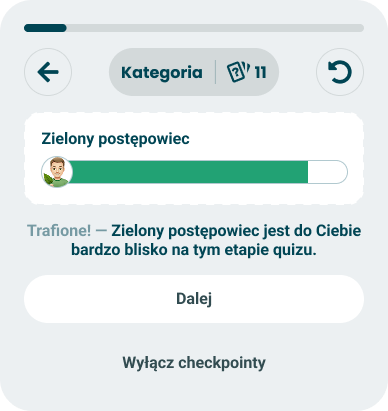 |
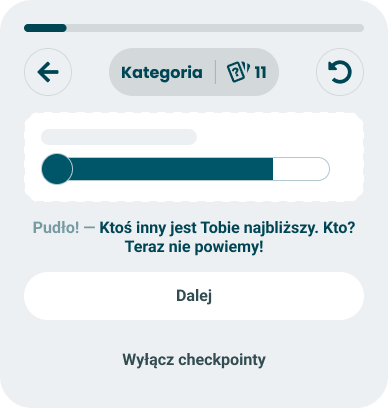 |
How it behaves:
- The options are whole positions, not poles - each one sits on two axes at once, so the guess is about which character the taker resembles rather than which side of a line they fall on.
- Three options, one of them true - the two distractors are the design work: too obvious and there is no game, too random and it is a lottery.
- A miss reveals nothing - unlike the single axis puzzle, the answer is withheld, because the closest position is the headline of the result screen and spending it here would give the ending away.
- The withholding is the hook - "we are not telling yet" turns a wrong guess into a reason to finish the quiz.
- Fires on separation - the closest position has to be clearly ahead of the runner-up, otherwise the answer we are marking against is arbitrary.
- Once per quiz - it is the most demanding card we show, and a second one would be a chore.
- Needs named positions - a quiz without archetypes cannot run this checkpoint at all.
The guess itself is worth keeping: what someone expects to be, next to what their answers make them, is a comparison no other part of the product collects.
Opportunity
- Curiosity with a real answer behind it - the taker is shown a genuine number and asked to name it, which is a puzzle rather than a quiz interruption.
- A miss still pays - withholding the answer converts the weakest outcome into anticipation instead of disappointment.
- Self-perception data - guess against measured position, at scale, is a dataset worth analysing on its own.
- Teaches the cast early - meeting three archetypes mid-quiz makes the result screen legible when it names one.
- Reuses what exists - the archetype row and the closeness bar are already built for the result.
Risk
- It can spoil the ending - even a hit hands over the headline of the result screen with half the quiz still to go.
- A miss is a dead end - the taker committed, got told they were wrong, and received nothing back; the copy is doing all the work of making that feel playful.
- One in three is a weak game - too few options and hits are cheap, too many and the card turns into a list nobody reads.
- Distractors are hard to pick well - they have to be plausible against this taker's position, which means generating them per taker, not per quiz.
- Committing to a character contaminates what follows - stronger than an axis guess, because the taker has now picked an identity and the remaining questions are a chance to live up to it.
- The position moves - the archetype that was closest at question 11 may not be the one on the result screen, and a taker who guessed it right will remember that we agreed with them.
- Not every quiz can run it - archetypes are optional in a quiz design, so the event model needs something else to reach for.