Axis closeness
Tells the taker where they already stand on one axis, once the reading is safe to state.
Decision: ⚪ idea
Design: Figma - single axis | double axis
Context
A passive card shown between questions. It names one axis, draws the taker's current position on it, and says what that position means in one sentence - see checkpoints for the shared card frame and event model for what makes it fire.
Two variants, one per axis type:
- Single axis - one orientation, filled from zero. "Your radicalism is high."
- Double axis - two opposing orientations, filled towards the leading side. "Your euroscepticism is greater than your federalism."
| Single axis | Double axis |
|---|---|
 |
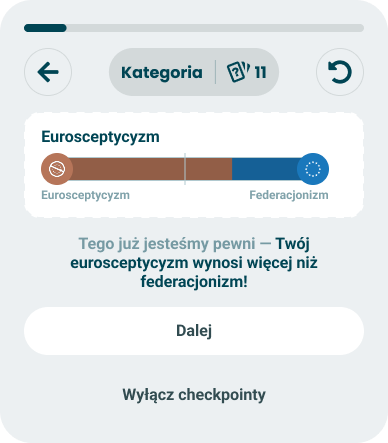 |
How it behaves:
- Reuses the result chart - the same single-axis and double-axis modules the result screen uses, so mid-quiz and final look like one product.
- Copy is lead-in plus statement - a grey opener that signals certainty, then the finding in bold. "We already know this - your radicalism is high."
- Fires on confidence, not on progress - the axis needs enough answers behind it and a clear enough lean. A near-tie has nothing worth saying.
- Once per axis - the same axis never gets two cards in one quiz, and the event model picks which axis wins when several qualify.
- Passive - no input, just continue, plus the checkpoint opt-out every card carries.
Opportunity
- Turns progress into payoff - eleven questions in, the taker gets a real finding about themselves instead of a progress bar, which is the whole gamification bet.
- Teaches the vocabulary early - by the time the result screen shows a dozen axes, the taker has already met one and knows how to read it.
- Cheapest checkpoint we have - it needs only the scores already being computed, no aggregates, no extra questions, no author configuration.
- Works in any quiz - every quiz has axes, so this is the one checkpoint that never needs a fallback.
Risk
- An early reading can be overturned - "your radicalism is high" at question 11 against a balanced final result makes us look wrong rather than early.
- It can change the answers that follow - telling someone what they are mid-quiz invites them to answer consistently with the label instead of honestly, which is a data quality problem, not just a UX one.
- Comparative phrasing confuses - "more eurosceptic than federalist" is easy to read as "you are a eurosceptic", which is not what the axis says.
- Choosing the axis is a ranking problem - a card about a dull axis burns the slot a striking one deserved.
- Wording carries judgement - "high radicalism" reads as a verdict, and on a political axis a verdict is exactly what we cannot be seen to hand out.