Single axis puzzle
Hides one axis, asks the taker to guess which side they came out on, then shows the real reading.
Decision: ⚪ idea
Design: Figma - ask | guessed right | guessed wrong
Context
The active counterpart to axis closeness. Same axis, same chart, but the fill is masked and the taker has to commit to a guess before it is uncovered - see checkpoints for the shared card frame and event model for what makes it fire.
The card runs in three states:
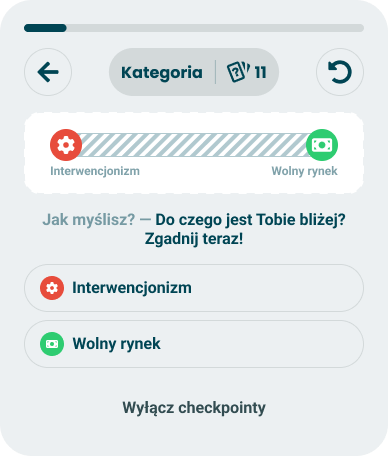
- Ask - the axis chart is drawn with the fill hatched over, both poles still named, and the poles are offered as the answer options. "What do you think - which one are you closer to? Guess now!"
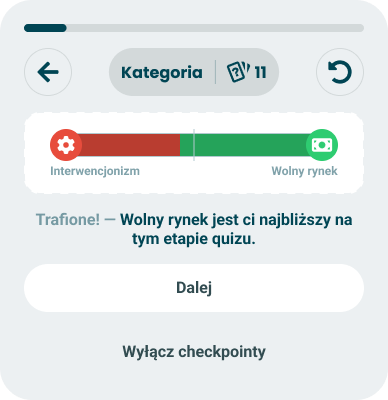
- Hit - the mask lifts to the real chart. "Got it - free market is the closest to you at this stage of the quiz."
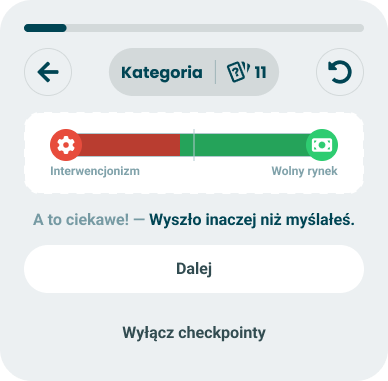
- Miss - the same reveal, framed as a surprise. "Now that's interesting - it came out differently than you thought."
| Ask | Hit | Miss |
|---|---|---|
 |
 |
 |
How it behaves:
- The options are the poles - a two-pole axis offers two rows, so the guess is a binary and there is nothing to hedge with.
- The guess is the only way forward - no continue button until an option is tapped, which is what separates this from a passive card.
- The reveal is immediate - the answer replaces the question in place, so the guess and the finding are read together rather than a few questions apart.
- Hit or miss, never right or wrong - a miss is interesting, not incorrect; the taker's expectation is not the thing being marked.
- Hedged to the moment - "at this stage of the quiz" is in the copy, so the reveal is a standing that can still move, not a verdict.
- Fires on confidence - the same gate as axis closeness; an axis sitting near a tie has no answer worth guessing at.
- Once per axis - an axis that got a puzzle does not also get a closeness card, and the event model picks which axis is worth the slot.
Open question: whether the reveal stays on the card or is deferred a few questions, which is how event model describes two-beat events. Immediate keeps the card self-contained; deferred buys a second beat of anticipation at the cost of a guess that can be left unresolved.
Opportunity
- A question earns the reveal - the taker asked for this finding, so it gets read instead of tapped past, which a passive card cannot guarantee.
- The gap is the product - the distance between what someone expects of themselves and what their answers say is the most interesting thing the quiz holds, and only a guess exposes it.
- The failure case is the strong one - a miss is the memorable outcome, so the mechanic works best exactly when it "fails".
- No new visuals - it reuses the axis modules the result screen already ships; the mask is the only addition.
- Works in any quiz - every quiz has axes, so it never needs a fallback.
Risk
- The most expensive interruption we have - it demands an answer mid-quiz, so it costs more of the pacing budget than any passive card.
- It contaminates the answers that follow - worse than axis closeness, because the taker has now committed to a self-image and the remaining questions are a chance to defend it.
- A miss can be rejected rather than absorbed - "that is not you", from a quiz that is half finished, is easy to read as the quiz being wrong.
- A coin flip is right half the time - two options make a hit cheap, which flattens both outcomes.
- An overturned reveal contradicts twice - the taker guessed against a mid-quiz reading; if the final result flips it, we were wrong about them and about their own guess.
- The poles have to be self-explanatory - forcing a choice between interventionism and free market assumes a vocabulary the taker may not have yet, and there is no way to answer "I don't know".