Answer model
The six kinds of answer a question can offer, and what each one costs the taker.
Decision: ⚪ idea
Context
A question is a statement plus a list of answers, and every answer is one of six kinds. The kind decides how it looks, how it reads, and what it does to the score.
The agreement scale carries almost every political question:
- Strongly agree - full weight behind the orientations the answer supports.
- Agree - the same direction, less of it.
- Disagree - the same, against.
- Strongly disagree - full weight against.
Two kinds exist for everything the scale cannot say:
- Custom - an answer the author writes, chosen instead of the scale. A question that is not an agreement question still fits.
- Custom selectable - an author-written answer that can be picked together with others, so one question can take several answers at once.
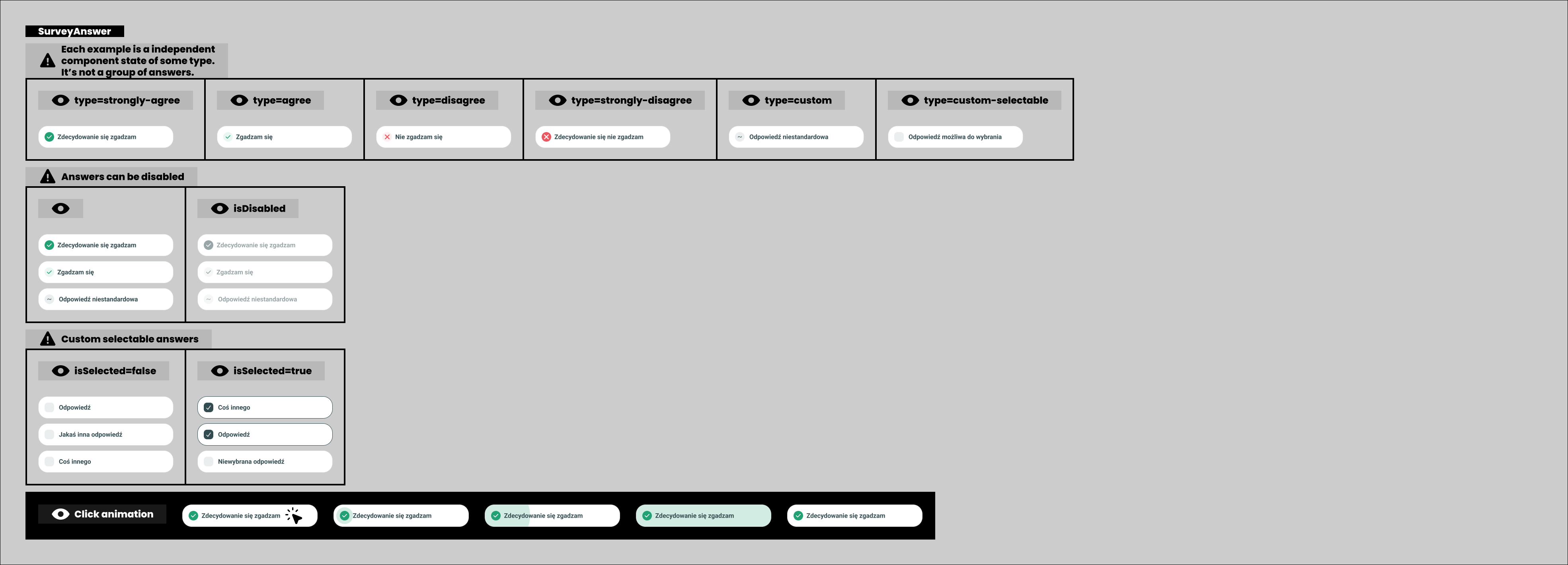
How they behave:
- One tap, immediately acknowledged - the answer reacts the moment it is pressed, before anything else happens. Over 50 to 100 questions that responsiveness is most of what pacing feels like.
- One answer per question, except when selectable - custom-selectable is the only kind where several can be on at once.
- Any answer can be disabled - visible but not choosable, so a question can show an option it will not accept right now.
- The answer is the unit that scores - orientations and weights hang off the answer, not the question, which is what lets one question feed several axes at once.
- Colour carries the meaning - green for agreement, red against, filled for the strong version. The grammar is learned in the first question and read without reading after that.
There is no neutral point. A four-step scale forces a lean, and a taker with no opinion has nothing to press unless the author adds a custom answer for it.
Opportunity
- Comparability - the same four steps in every quiz and every year is what makes pooled analysis and answer statistics possible at all.
- A forced lean produces a usable score - a midpoint would collect the answers that say the least.
- Custom answers stop the format being a straitjacket - a factual or preference question can live in the same quiz as the scale.
- The cheapest possible interaction - one tap per question is what makes a 100-question quiz survivable, and what makes swipe or keyboard input a later addition rather than a rewrite.
- Weights sit on answers - authors can express that agreeing strongly with one statement says more than agreeing with another, without new question types.
Risk
- No neutral forces an opinion - a taker who genuinely has none either abandons the quiz or answers noise, and we cannot tell which.
- Custom answers break comparability - a quiz built on them produces data that pools with nothing else.
- Multi-select changes the maths - several answers to one question need their weights normalised, or that question quietly counts more than its neighbours.
- "Strongly" is not a measurement - one taker's strong agreement is another's agreement, and we treat both as numbers.
- Author freedom is uneven - community quizzes will mix scales and custom answers inside one quiz in ways that read as inconsistent.
- A disabled answer looks like a bug - an option that can be seen but not pressed needs a reason the taker can see too.